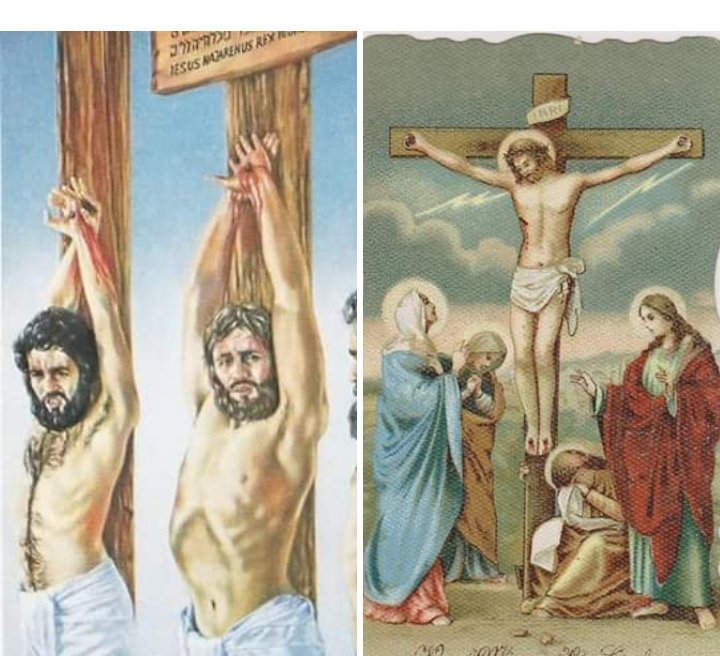
According to the doctrine of Jehovah’s Witnesses, Christ was hung on a stake, not a cross. Already in the Greek koinè (the biblical one) the Greek word “σταυρός” (transliterated: “stauròs”) translates as “pole”, but also “cross”. The Gospels provide us with some elements that exclude that Christ was hung on a pole rather than a cross. First of all, the crucifixion was a sentence inflicted by the Romans on slaves, rebels and criminals. It was a shameful and cruel form of execution, and death came slowly, by suffocation. Christ was crucified by the Romans (Matthew 9:19; Mark 10:33; 15:1-25), on a cross, not on a stake. The condemned to death by crucifixion carried not the entire cross, but only the horizontal arm or wood, called the “patibulum”. Arriving at the place of execution, the patibulum was fixed on the upright wood, which in the New Testament is called “ξύλον” (transliterated: “xỳlon” [Acts 5:30; 10:39; 13:29; Galatians 3:13; 1 Peter 2:24]). The nails were driven into the forearms, between the ulna and the radius. Not in the hands, since the weight of the condemned man’s body would have caused the laceration of the hands, therefore the fall from the cross. On the cross, above the head of Jesus, they placed the written reason for his condemnation: “Jesus the Nazarene, the king of the Jews” (John 19:19). If he had been hung on a pole instead of a cross, that inscription would have been placed above his hands, not above his head. After his resurrection, when the other apostles said to Thomas: So the other disciples told him, “We have seen the Lord!” But he said to them, “Unless I see the nail marks in his hands and put my finger where the nails were, and put my hand into his side, I will not believe.” (John 20:25) Thomas speaks of the “the nail marks” in the hands of Jesus, not of “the nail one mark”. Therefore Jesus had to be not with his arms closed, above his head, with one hand on the other as in the pictures in the Watchtower, but rather with arms wide open, as in the pictures in the Catholic Church, with a nail driven into each hands. The Greek word used by John and translated as “hands” is “χεῖράς” (transliterated: “cheiras”), from “χεὶρ” (transliterated: “cheir”), which indicates not only the hand, but also the whole arm. The Jewish writer Josephus (37-100 AD) writes that Jesus was “punished by the cross” (Jewish Antiquities XVIII, 63-64). Alessameno’s graffiti, dating from the middle of the third century, shows a crucifix with the head of a donkey, dressed in a short sleeveless tunic. It is seen from behind. To the left of the crucifix a man is depicted, also wearing a short sleeveless tunic. He has one arm raised. Between the man with the raised arm and the crucifix with the donkey’s head, there is a Greek inscription: “Αλεξαμενος σεβετε θεόν” (transliterated: “Alexamenos sebete theon”) which means: “Alexamenus worships his god”. a blasphemous representation of the crucifixion of Christ. In fact, according to what Tertullian (155-230 AD) stated, Christians were unjustly accused of worshiping a god with the head of an ass (Apologeticum XVI, 1-2). Christians mark their foreheads with a small sign of the cross (De Corona 3). This is why Jesus Christ was hung on a cross, not on a stake. His arms outstretched on the cross make us think of the love of God that embraces all men.
 Cristiani Cattolici Romani