Titus 2:13
New World Translation
While we wait for the happy hope and glorious manifestation of the great God and of our Savior, Jesus Christ.
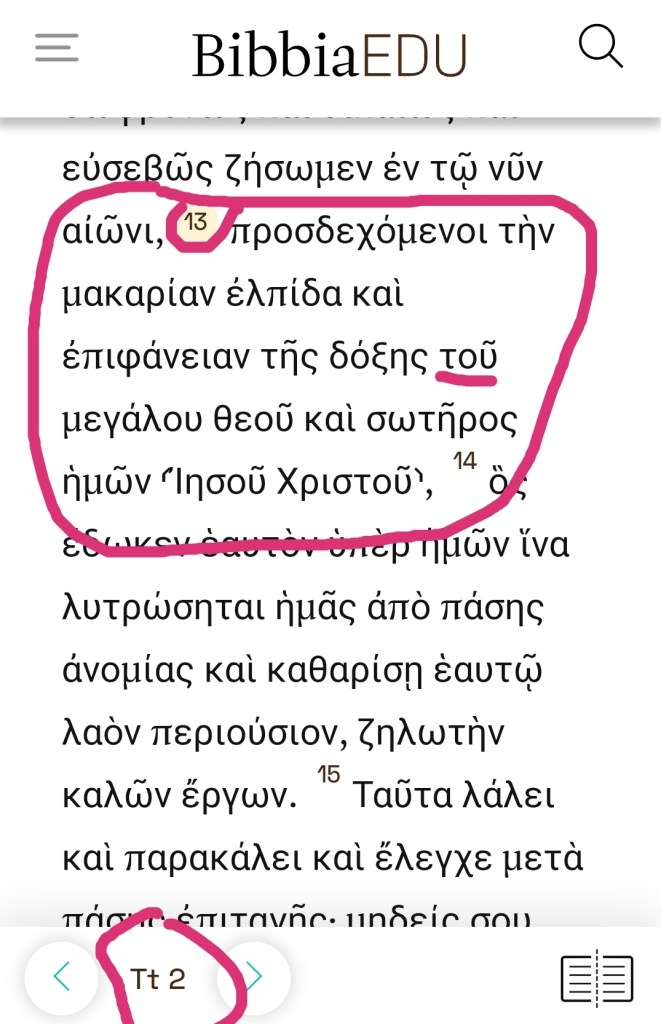
To deny the divinity of Jesus Christ, the anonymous authors of the New World Translation altered Titus 2:13 by adding a second “of” in the text, in front of “our Savior Jesus Christ.” In fact, in the Greek text appears only once “tou”, that is “of”, in front of “megalou Theou” which means “great God”.
The Greek text is as follows:
Prosdecomenoi tēn makarian elpida kai epiphaneian tēs doxēs tou megalou Theou kai Sōtēros hēmōn Iēsou Christou.
The Greek text has “kai Sōtēros” (and Savior), not “kai tou Sōtēros” (and of Savior), and therefore it should be translated as follows:
Waiting for the blessed hope and the manifestation of the glory of our great God and Savior Jesus Christ.
In his pastoral letter, Paul clearly states that Jesus Christ is “our great God and Savior”. Moreover, in the New Testament, the “coming” and the “manifestation” are always attributed to Jesus (Matthew 16:27; 24:26.27.44; Acts 1:11; 1 Thessalonians 4:16; Philippians 3:20; Titus 2:13; 1 John 2:28; Revelation 1:7), never to the Father. The anonymous authors of the New World Translation introduced the same alteration in 2 Peter 1:1.
Here are the names of some international translations, which differently from the New World Translation report a correct translation of the text of Titus 2:13
English Standard Version, Berean Study Bible, Berean Literal Bible, King James Bible, New King James Version, New American Standard Bible, NASB 1995, NASB 1977, Amplified Bible, Christian Standard Bible, Holman Christian Standard Bible, American Standard Version, Aramaic Bible in Plain English, Contemporary English Version, Douay-Rheims Bible, Good News Translation, International Standard Version, Literal Standard Version, New American Bible, NET Bible, New Revised Standard Version, New Heart English Bible, World English Bible, Young’s Literal Translation, Vulgata, Martini, TILC, CEI, Riveduta, Nuova Riveduta, Diodati, Nuova Diodati, Bibbia della Gioia, Louis Segond Bible, Martin Bible, Darby Bible, LBLA, JBS, NBLA, Lutherbibel 1912, Lutherbibel 1984, Textbibel 1899, Modernisiert Text.
When Scripture distinguishes Jesus from God, it is because it is distinguishing the person of the Son from that of the Father, and not because it is denying the divinity of Jesus, spelled out in many other scriptures (John 20:28; Acts 20:28; Colossians 2:9; Titus 2:13; 2 Peter 1:1). In fact, whenever Scripture distinguishes Jesus from the Father, while the latter is called “God”, Jesus is called “Lord” (1 Corinthians 8:6; Romans 10:9). But God himself is “Lord” (Genesis 9:26; 13:4; 14:22) and “only Lord” (Deuteronomy 6:4; Mark 12:29). And calling Jesus “Lord” (Philippians 2:11; 1 Corinthians 12:3) and “only Lord” (1 Corinthians 8:6; Jude 1:4) and “Lord of all” (Acts 10:36; Romans 10:12) , Scripture clearly tells us that he is God. Attention, this is not a second God, since Jesus is one God with the Father (John 10:30), because he participates fully in the same and indivisible nature of the Father (John 16:15).
The Greek text is attached in the photo
 Cristiani Cattolici Romani